
To view this letter in PDF Format lease click here: 2026-Q2 PBCM Investor Letter
Welcome to our new investors and thank you to our existing clients and partners for your continued support. We are pleased to present our results for the most recent quarter in the following pages.
After reading this letter, please do not hesitate to contact us if you have any questions, want to discuss any topics in greater detail, or would like to learn more about our Concentrated Value portfolio. We can be easily reached via e-mail at info@pelicanbaycap.com. We welcome your feedback and look forward to your correspondence.
Coming into the year, we believed the Concentrated Value Strategy was well-positioned to continue our success from 2025. Late last year, we had the opportunity to cycle funds into several new investments that represent high-quality companies at very attractive valuations.
In the first quarter of 2026, we were very pleased with the portfolio’s results as the portfolio generated a 4.3% return for investors net of fees in a choppy market versus our benchmark’s gain of 2.1%. However, as the calendar turned to April, we gave up those relative gains and then some. The Russell 1000 Value Index surged by an incredible 13.8% in the second quarter, led by remarkably large gains in semiconductor and hardware-related stocks, which contributed 10.5% to the index’s return as exuberance for the AI trade flourished. I cannot recall the last time a subsector had such an overpowering influence on a broad index.
Our Concentrated Value Portfolio had no meaningful exposure to the AI boom outside of a small position in Cisco, resulting in a modest 2.1% gain for the quarter. This drove our widest relative underperformance versus the benchmark since the COVID-19 pandemic in Q1 2020. While it is not uncommon to give up some relative ground after a long stretch of outperformance, the magnitude of this gap due to AI euphoria was extreme.

The important question is: does this change our expectations for the portfolio from the beginning of the year? Absolutely not. The strategy continues to hold high-quality companies with strong cash flows, defensible business models, and healthy balance sheets. Most importantly, these businesses currently trade at substantial discounts to what we believe are their intrinsic value ranges. Our investment philosophy and the opportunity set within our portfolio did not change simply because our benchmark temporarily became a vehicle for expressing the exuberance of the massive AI data center buildout. As you can see from the table below, our portfolio compares very favorably to the benchmark.
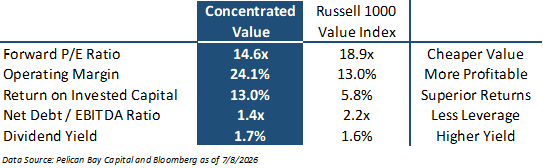
We believe these financial metrics are indicative of higher-quality companies, and they are certainly superior to the average company in the benchmark. As it stands now, these higher-quality businesses trade at a substantial discount to the wider index. Consistent with our investment philosophy, we believe over time, higher-quality companies should not trade at a discount; that gap should close, providing a strong opportunity to deliver alpha for our investors.
Turning to our performance for the quarter, unsurprisingly, our strongest contribution to returns came from Cisco Systems (CSCO), which jumped 63.5% in sympathy with other AI hardware companies. This surge has pushed Cisco to the top end of our estimated intrinsic value range. We have trimmed our position, and the stock now represents our smallest holding in the portfolio. We will exit the position entirely if shares continue to advance past our intrinsic value range or if we identify a superior investment opportunity.
Elevance Health (ELV) continued to recover from a weak Medicare Insurance market as management successfully repriced plans to account for higher medical costs. The company is also exiting unprofitable Medicaid programs, shifting pharmaceutical spending to its in-house PBM, and continuing to take market share from UnitedHealthcare in the Commercial Insurance space. Royalty Pharma (RPRX), another healthcare holding, marched higher as investors gained confidence in management’s ability to acquire new royalties on attractive terms. Following this steady share price increase, RPRX has become our largest portfolio holding.
Toll Brothers (TOL) rounded out our top contributors despite general weakness in the homebuilding sector. Toll is benefiting from exposure to affluent clients who have gained significantly from years of strong stock market performance. Because these buyers largely pay cash for their homes, they are also insulated from the headwinds of elevated mortgage rates, making Toll a rare bright spot in the industry today.
You can find a complete list of the portfolio’s top contributors and detractors for the second quarter of 2026 in the table below.
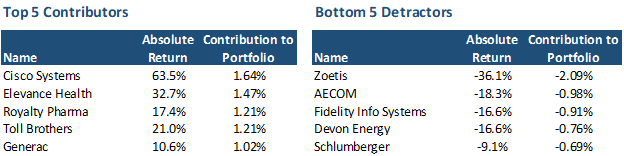
On the negative side, we suffered only one real setback. One of our newer holdings, Zoetis (ZTS), fell sharply after its first-quarter earnings report. The company’s legacy dermatology treatments and parasite franchises continue to lose share to lower-priced competition, as pet owners struggling with macroeconomic headwinds try to reduce veterinary spending. We believed these headwinds were already well understood, and the magnitude of the sell-off following their Q1 earnings release took us by surprise. However, we continue to believe that animal health spending will increase and that Zoetis is well positioned with a strong product pipeline to support high single-digit sales growth for years to come. Consequently, we added to our position after the sell-off.
Falling energy prices, following the Trump Administration’s pursuit of a ceasefire agreement with Iran, also detracted from the portfolio as our energy-exposed companies declined marginally. Both Devon (DVN) and Schlumberger (SLB) landed on our list of the bottom five detractors for the quarter.
Devon is our newest portfolio addition. The company possesses top-tier oil and gas assets in the Delaware Basin, which are now paired with strong natural gas production in Pennsylvania and Oklahoma. Having recently closed its large acquisition of Coterra Energy, the combined entity is now the largest exploration and production company in the United States. Devon boasts a clean balance sheet and is positioned to generate substantial free cash flow in the coming years.
Based on our analysis at the time of purchase, we believe the stock was pricing in conservative commodity prices of approximately $62 for oil and $2.80 for gas, which we view as far too low. Furthermore, the stock trades at roughly ten times free cash flow, and management recently announced an $8 billion share repurchase program representing an impressive fourteen percent of the current market cap. We believe Devon is intrinsically worth $70 to $110 per share, compared to a price of $50 dollars when we initiated our position.
While we recognize that the portfolio already has exposure to energy through our investments in Diamondback (FANG) and EOG, this addition brings our combined energy weighting to just under fifteen percent. We believe energy assets are materially mispriced given the supply shocks stemming from the closure of the Strait of Hormuz. Additionally, we expect U.S. natural gas prices to converge with international pricing over the next few years as new liquefied natural gas export capacity comes online and domestic electricity demand surges due to the ongoing data center buildout.
We also exited our positions in Generac (GNRC) and CBOE Global Markets (CBOE), as both companies rose well above the top end of our estimates of intrinsic value. We sold on success, staying true to our valuation-based sell discipline. Regarding the remainder of our trading activity during the quarter, we added to Builders FirstSource (BLDR), Ulta Beauty (ULTA), Fidelity National Information Services (FIS), and AECOM (ACM) on price weakness. We trimmed Old Dominion Freight Line (ODFL) as it quickly moved into the upper half of its estimated intrinsic value range, and its large size in the portfolio became inappropriate relative to the remaining opportunity for outsized gains.
Lastly, we wanted to revisit the Investment Philosophy of the Concentrated Value portfolio. We utilize a value investment strategy that seeks out companies for investment which the Portfolio Manager deems to be high quality companies. Quality is defined by possessing business operations with durable competitive advantages, allowing for high returns and growing cash flows streams. We want these high-quality companies to also have solid balance sheets, preferably with a net cash position. We also prefer that their management teams make decisions with an emphasis on maximizing shareholder returns.
Once we find these high-quality companies, we generally only invest in their stock if they trade at a steep discount to our estimate of their intrinsic value. This is necessary to provide our investors with the opportunity to generate an above-market return and protect capital. This discipline creates a wide margin of safety if an undesirable scenario plays out in the future. Pelican Bay Capital Management believes that identifying a significant difference between the daily market value of a security and the intrinsic value of that security is what defines an investment opportunity.