
To view this letter in PDF Format lease click here: 2026-Q1 PBCM Investor Letter
Welcome to our new investors and thank you to our existing clients and partners for your continued support. We are pleased to present our results for the most recent quarter in the following pages.
After reading this letter, please do not hesitate to contact us if you have any questions, want to discuss any topics in greater detail, or would like to learn more about our Concentrated Value portfolio. We can be easily reached via e-mail at info@pelicanbaycap.com. We welcome your feedback and look forward to your correspondence.
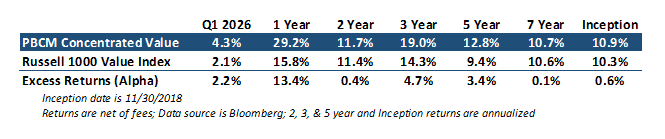
The Concentrated Value strategy started the year on a strong note, outperforming the Russell 1000 Value Index by 2.2% during the first quarter. This represents our fourth consecutive quarter of outperformance, during which the portfolio has returned 29.2% against the benchmark’s 15.8%. Most importantly, this recent streak of performance has allowed us to erase the 2024 deficit and resume our trend of long-term alpha generation.
Our performance this quarter was primarily driven by our exposure to the Energy sector and our continued lack of exposure to the “Magnificent Seven” stocks that dominate the broader indices. These gains were partially offset by weakness in our consumer-related holdings and interest-rate-sensitive companies.
Within our top contributors, energy names like EOG Resources (EOG), Schlumberger (SLB), and Diamondback Energy (FANG) were standout performers, reflecting our long-held conviction in the sector’s underlying value. The sector was buoyed by a sharp surge in crude oil prices, which averaged over $72 per barrel for NYMEX WTI during the quarter and spiked toward $90 in March. This price appreciation was largely fueled by escalating Middle East conflicts that heightened global supply concerns. EOG Resources specifically benefited from these stronger realizations, which significantly improved their pre-tax income outlook. Schlumberger saw a notable recovery in service demand toward the end of the quarter as global upstream activity stabilized. You can find a list of the portfolio’s top contributors and detractors in the table below.
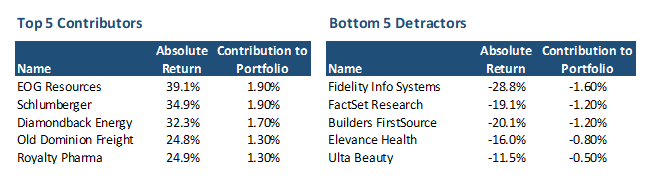
On the negative side, Fidelity Information Services (FIS) weighed on performance despite meeting 2025 targets. Investors reacted cautiously to their 2026 outlook and the complex integration of the Total Issuing Solutions acquisition, alongside a temporary pause in share repurchases as the company focuses on deleveraging. FactSet Research (FDS) suffered from a broader, indiscriminate sell-off in software stocks, as well as a decrease in operating margins due to higher technology and compensation expenses. Builders FirstSource (BLDR) faced headwinds from a cooling residential construction environment, with expectations for significantly lower year-over-year earnings as the market reassesses demand in the face of elevated rates.
Elevance Health (ELV) saw its results impacted by a substantial $935 million accrual related to a CMS Medicare Advantage risk adjustment notice. While underlying adjusted earnings grew by 5% and the company raised its full-year guidance, the regulatory charge weighed on the share price. Finally, Ulta Beauty (ULTA) saw shares decline as the market adjusted for a more normalized growth environment following a strong 2025. Despite healthy comparable sales growth, the stock traded down as it reached our estimated ceiling of fair value, prompting our decision to trim the position.
The first quarter saw elevated trading activity as we moved to recycle capital from fully valued winners into new opportunities. We fully exited our remaining position in Micron (MU). Micron has been a significant winner for the portfolio; however, the shares are now well above our estimate of fair value. We have growing concerns that the current chip shortage—which has driven recent share strength—could subside as Micron, Samsung, and SK Hynix all bring new memory capacity online next year.
We also trimmed our positions in EOG Resources, Diamondback Energy, Generac (GNRC), Ulta Beauty, and CBOE Global Markets (CBOE). In the fourth quarter of 2025, many of these same names came under selling pressure and we had added to our positions at the time. After quick recoveries, and as they moved into the upper end of our fair value ranges, we took the opportunity to harvest gains. Specifically, we trimmed Ulta Beauty at $658 per share, which represents the top of our estimated fair value range.
Conversely, we used price weakness to add to Brown-Forman (BF.B) and significantly increased our position in FactSet. Software stocks are currently being sold indiscriminately following recent results from PayPal and ServiceNow, as investors fear Artificial Intelligence will eliminate traditional software business models. We do not share this view, particularly regarding FactSet. Their proprietary data sets and portfolio reporting tools are deeply embedded in client workflows and, in our view, difficult to replace with generic AI tools. With the stock trading at just 13x our estimates of earnings, we moved from an initial stake to a full position.
Finally, we initiated a new investment in Zoom Video Communications (ZM). The portfolio remains fully invested with 20 positions.
Zoom is the global leader in modern enterprise video communications. While the company became a household name during the pandemic, its success is built on a foundation of simplicity, performance, and the seamless integration of AI productivity tools.
The current investment controversy surrounding Zoom centers on its ability to transition from a pandemic-era utility to a diversified enterprise collaboration platform. Investors worry about “bundling” from tech giants like Microsoft and Google, who offer communication tools within broader software ecosystems at no additional cost. Furthermore, there are widespread fears that AI generated “vibe-coding” could cheaply replace enterprise software.
We believe these fears are overdone for several reasons. Most importantly, While Microsoft Teams has a massive footprint, Zoom continues to grow their revenues each year which we believe is mostly likely due to the simplicity and functionality of their user interface, which is an important factor for high-stakes external video events and sales calls where ease of entry for non-technical users is paramount.
Additionally, we think “vibe-coded” software is a very low threat for Video Solutions like Zooms. It is technically challenging to replicate a secure video stream, let alone multiple streams. On the contrary, we think Zoom is an AI beneficiary. They are adding AI tools that will make their product stickier for clients including note taking and translating meeting conversations into assigned tasks and coordinated actions in third-party systems like Jira or Salesforce. Moreover, the primary culprit in helping companies generate their own code and software is Claude AI, which is owned by Anthropic. However, Zoom owns a significant stake in Anthropic and because of that stake has partnered with Zoom.
In fact, a key component of our valuation that the market is largely ignoring is Zoom’s strategic stake in Anthropic, a leading AI model developer. Recent analysis suggests this stake alone could be worth $10–$13 per share. This provides Zoom with both a financial cushion and a “front-row seat” to the latest advancements in Large Language Models (LLMs).
Zoom’s underlying business generates substantial free cashflow and the company has a balance sheet that is nearly unparalleled in the software space. As of the end of the fiscal year, the company held $7.8 billion in net cash and marketable securities that are approximately $26 per share. We estimate the normal earnings power of the underlying business at $4-$6 per share. Applying a 14-16x multiple to those earnings—appropriate for its profitability and growth profile—results in a business value of $56-$96 per share.
When we aggregate the cash, the Anthropic stake, and the core business value, we arrive at an estimated intrinsic valuation range of $92–$135 per share. We were pleased to acquire our shares during the quarter for $89 per share, representing a significant discount to what we believe is a conservative appraisal of the business’s assets and future earnings power.
Lastly, we wanted to revisit the Investment Philosophy of the Concentrated Value portfolio. We utilize a value investment strategy that seeks out companies for investment which the Portfolio Manager deems to be high quality companies. Quality is defined by possessing business operations with durable competitive advantages, allowing for high returns and growing cash flows streams. We want these high-quality companies to also have solid balance sheets, preferably with a net cash position. We also prefer that their management teams make decisions with an emphasis on maximizing shareholder returns.
Once we find these high-quality companies, we generally only invest in their stock if they trade at a steep discount to our estimate of their intrinsic value. This is necessary to provide our investors with the opportunity to generate an above-market return and protect capital. This discipline creates a wide margin of safety if an undesirable scenario plays out in the future. Pelican Bay Capital Management believes that identifying a significant difference between the daily market value of a security and the intrinsic value of that security is what defines an investment opportunity.